
Water Analyses
Isotech offers numerous types of compositional and isotopic analyses for water samples. We also offer sampling products and advice to assist you in collecting good, representative samples. If you have a specific need not listed, please contact us.
Dissolved Gas
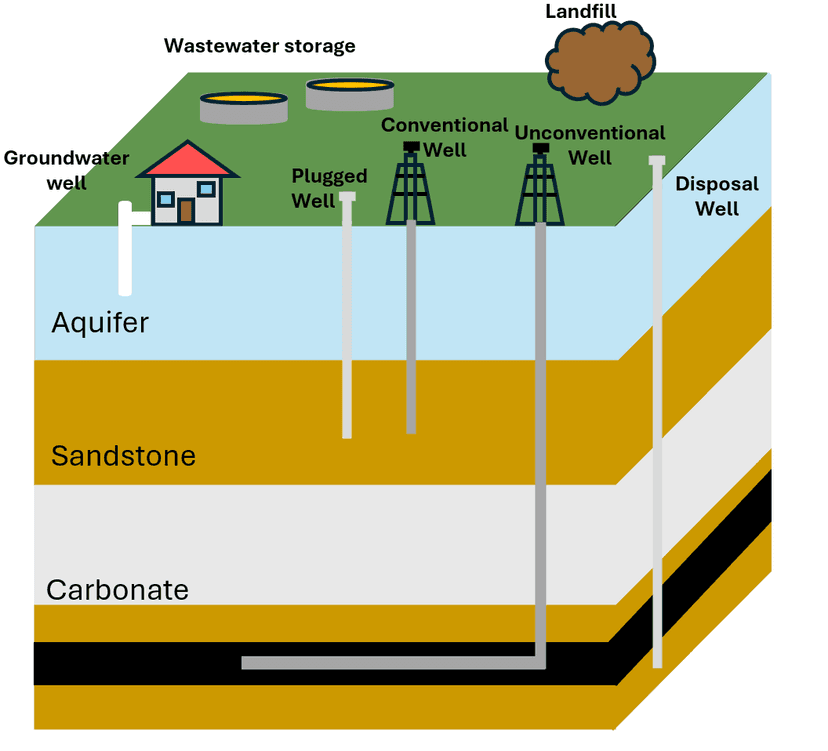
Our team determines the dissolved gas composition of water samples collected in IsoFlasks®. Analytical reports include a full compositional and isotopic analysis of the headspace and dissolved gas concentrations in the water for methane, ethane and propane. Dissolved gas concentrations are available for additional components upon request. Below is a diagram showing some sources of stray gas that could migrate into a groundwater well.
Sampling Guidelines
Sample Container
The IsoFlask is the recommended container for this analysis. Other containers used are HDPE bottles with septum integral to the cap, flip top style glass bottles and VOA vials.
Sample Size
We recommend that you fill the IsoFlask with 600-750 mL of water for dissolved gas analysis. If you wish to use a bottle method for collection please contact us for recommendations. Note that other sampling containers may over or under represent the gas content of the water. We do have the capability to analyze dissolved gas from 40 mL VOA vials or similar sized containers. However, the amount of gas available could severely limit the isotopic work possible.
Preservative
IsoFlasks have a biocide that prevents microbial action and should be kept from excessive heat and sunlight. Other containers require refrigeration and shipment on ice.
Holding Time
IsoFlasks can be held unrefrigerated for up to two months. For other containers, if the sample is kept refrigerated, we recommend shipping the sample to us with in two weeks of sampling.
Shipping
IsoFlasks can be shipped using your preferred method. For other containers, we recommend the sample be shipped on ice and overnighted to the lab. Please do not ship on a Friday as we only receive samples Monday through Friday.
Analysis Suites
| Analytes/properties tested for | GC Only | DG-1 | DG-2 |
|---|---|---|---|
| Dissolved Gas GC | yes | yes | yes |
| Concentration of methane, ethane, and propane dissolved in water | yes | yes | yes |
| δ13C and δD of methane | no | yes | yes |
| δ13C of ethane and propane | no | no | yes |
Questions we can answer
- Are there explosive concentrations of methane in a groundwater well?
- What processes are responsible for methane in my water source? Is microbial methane present in my water source?
- Did natural gas from a producing gas well, a gas storage facility, or a landfill migrate into a water source?
- Did a remediation project reduce or eliminate hydrocarbon contamination in an aquifer?
- Is a groundwater well contaminated with brine or hydrocarbon gas and what was the source of that contamination?
- If multiple sources of methane are present in a water sample, what proportion is from microbial processes? What proportion is from gas migration from a producing gas well? If multiple producing wells cause gas migration into a water well, what proportion of gas is from each well?
Stable Isotopes
δD and δ18O: Groundwater
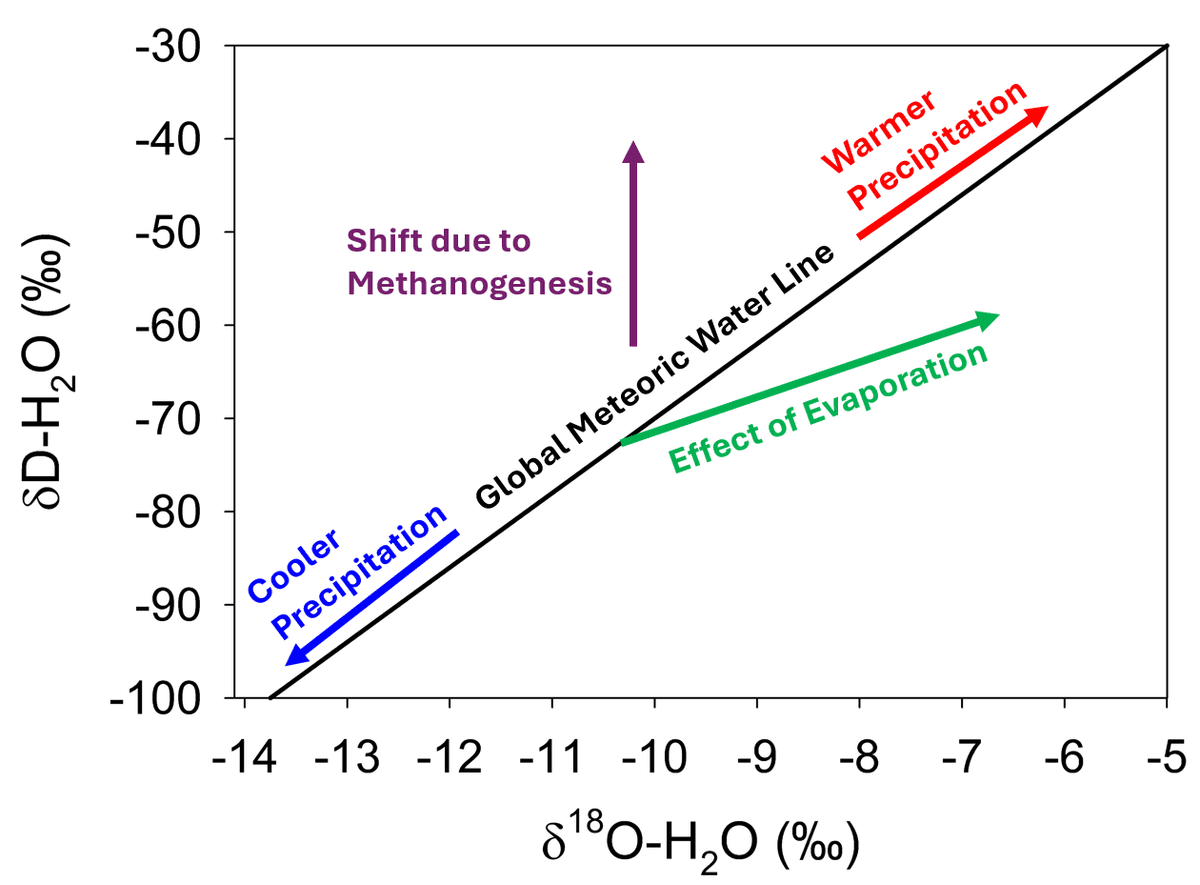
We have multiple technologies to analyze the isotopic composition of surface water, groundwater, and deeper produced brine water. Laser Spectrometry allows us to analyze waters more efficiently and cost effectively.
Sample Size
If you are only analyzing δD and δ18O, 2 to 60 mL is sufficient. If you require analysis on smaller volumes please contact us.
Sample Container
HDPE, plastic, or glass bottle. Plastic is preferred for shipping safety.
Preservative
None required if only analyzing δD and δ18O.
Holding Time
If the bottle is air tight a year holding time is reasonable.
Shipping
No special considerations required with shipping. Please include a Chain of Custody (COC) form.
δD and δ18O: Production Waters
Production waters and high salinity brines require vacuum distillation and CF-IRMS analysis.
Sample Size
If you are only analyzing δD and δ18O, 5 to 60 mL of recoverable water is sufficient. If you require analysis on smaller volumes please contact us.
Sample Container
HDPE, plastic, or glass bottle. Plastic is preferred for shipping safety.
Preservative
None required if only analyzing δD and δ18O.
Holding Time
If the bottle is air tight a year holding time is reasonable.
Shipping
No special considerations required with shipping. Please include a Chain of Custody (COC) form.
δ13C of Dissolved Inorganic Carbon
Water samples are acidified and analyzed via a Gas Bench and CF-IRMS.
Sample Size
Minimum-25 mL, ideal-150 mL. If you require analysis on smaller volumes please contact us.
Sample Container
HDPE, plastic, or glass bottle. Plastic is preferred for shipping safety. The sample should not have air included in the bottle.
Preservative
Filter the sample with at least a 0.45 micron or smaller pore-size diameter filter. The sample should also be kept on ice to minimize any microbial action.
Holding Time
If the sample is kept refrigerated, we recommend shipping the sample to us with in two weeks of sampling.
Shipping
We recommend the sample be shipped on ice and overnighted to the lab. Please do not ship on a Friday as we only receive sample Monday through Friday.
Questions we can answer
- Are deeper brine fluids migrating into a drinking water aquifer?
- What is the source of water in an aquifer?
- What water source(s) is recharging an aquifer?
- Where is water sourced from that is contaminated with nitrate/toxic metals?
- Are injected produced fluids leaking into shallower aquifers?
- Is water used for injection for enhanced oil recovery being produced by the oil well?
Radioisotopes
Carbon-14 (14C) of Dissolved Inorganic Carbon
Water is acidified and the resulting carbon dioxide is collected and sent to Beta Analytic for AMS analysis. Results are reported in percent modern carbon (pMC).
Sample Size
Minimum-70 mL, ideal-250 mL. If you require analysis on smaller volumes please contact us.
Sample Container
HDPE (plastic) or glass bottle. Plastic is preferred for shipping safety. The sample should not have air included in the bottle.
Preservative
Filter the sample with at least a 0.45 micron or smaller pore-size diameter filter. The sample should also be kept on ice to prevent any bacterial action.
Holding Time
If the sample is kept refrigerated, we recommend shipping the sample to us with in two weeks of sampling.
Shipping
We recommend the sample be shipped on ice and overnighted to the lab. Please do not ship on a Friday as we only receive sample Monday through Friday.
Tritium Analysis via Scintillation Counter
Analysis is effective when elevated tritium concentrations are expected such as landfill and nuclear event studies. The quantifiable limit for direct count is 10-15 tritium units (TU) based on the specific statistics of the run. Smaller concentrations will be reported as a less than value based on the statistics.
Sample Size
We recommend sending in 50 mL of water. Analyses on smaller amounts are possible. If you wish to analyze less than 10 mL please contact us first.
Sample Container
We recommend a HDPE (plastic) bottle.
Preservative
No preservative or cooling is required. Ensure that the bottle is air tight to prevent evaporation.
Holding Time
Samples should be sent in within six months of sampling.
Shipping
No special considerations are needed in shipping these samples. Please include a Chain of Custody (COC) form.
Electrolytic Enrichment to measure tritium concentration
For tritium levels at or below modern levels electrolytic enrichment is suggested. The quantifiable limit for electrolytic enrichment is approximately 1TU. Smaller concentrations will be reported as a less than value based on the statistics.
Sample Size
We recommend sending 1 liter of water. Analysis on smaller amounts is possible. If you wish to analyze less than 500 mL please contact us first.
Sample Container
We recommend a 1 liter HDPE (plastic) bottle.
Preservative
No preservative or cooling is required. Ensure that the bottle is air tight to prevent evaporation.
Holding Time
Samples should be sent in within six months of sampling.
Shipping
No special considerations are needed in shipping these samples. Please include a Chain of Custody (COC) form.
Questions we can answer
- How old is the groundwater in an aquifer system?
- Are there relationships between the relative ages of groundwater and water quality?
- Did landfill gas migrate into a groundwater well?
- Did fluids from producing oil/gas wells migrate into a landfill?
- Is water in an aquifer from recent precipitation (modern) or from an older source?
- Are nuclear waste fluids migrating into an aquifer?
Sulfur
Dissolved Sulfate Isotopes
δ34S and δ18O of Sulfate is analyzed by isolation via precipitation and then EA/TCEA-IRMS analysis. A minimum concentration of 5 mg/L is required for analysis.
Sample Size
We recommend sending 1 liter of water. Analyses on smaller amounts are possible. If you wish to analyze less than 500 mL please contact us first.
Sample Container
We recommend a 1 liter HDPE (plastic) bottle.
Preservative
The sample should be field filtered using at least 0.45 micron or smaller pore-size diameter filter. The sample must be kept chilled to minimize microbial action.
Holding Time
Samples should be sent in within two weeks of sampling.
Shipping
Samples must be shipped on ice and overnighted to our lab. Do not ship on a Friday as there is no one to receive the sample and put in refrigeration over the weekend. Please include a Chain of Custody (COC) form.
Dissolved Hydrogen Sulfide (H2S) Isotopes
H2S is exsolved from solution, converted to silver sulfide and analyzed via EA-IRMS analysis. A minimum concentration of 3 mg/L is required for analysis.
Sample Size
We recommend sending 1 liter of water. Analyses on smaller amounts are possible. If you wish to analyze less than 500 mL please contact us first.
Sample Container
We recommend a 1 liter HDPE (plastic) bottle. The bottle should have no headspace. Fill the bottle with a surface tension bubble and cap.
Preservative
The sample must be kept chilled to minimize microbial action. It is recommended that 1mL of 25% NaOH is added.
Holding Time
Samples should be overnighted to the laboratory. Sampling events should be planned for Monday through Thursday to allow receipt of the sample within 48 hours. If shipment of the sample cannot happen the same or next day the sample should be frozen.
Shipping
Samples must be shipped on ice and overnighted to our lab. Do not ship on a Friday as there is no one to receive the sample and put in refrigeration over the weekend. Please include a Chain of Custody (COC) form.
Questions we can answer
- What is the source of sulfate or hydrogen sulfide (H2S) in a groundwater well or in produced fluids from an oil or gas well?
- What processes are controlling the formation of sulfate (water rock interactions, thermochemical sulfate reduction, microbial processes)?
- Is this naturally occurring sulfate/H2S or is oil and gas drilling forming sulfate/H2S?
Nitrate Isotopes
δ15N and δ18O of Nitrate
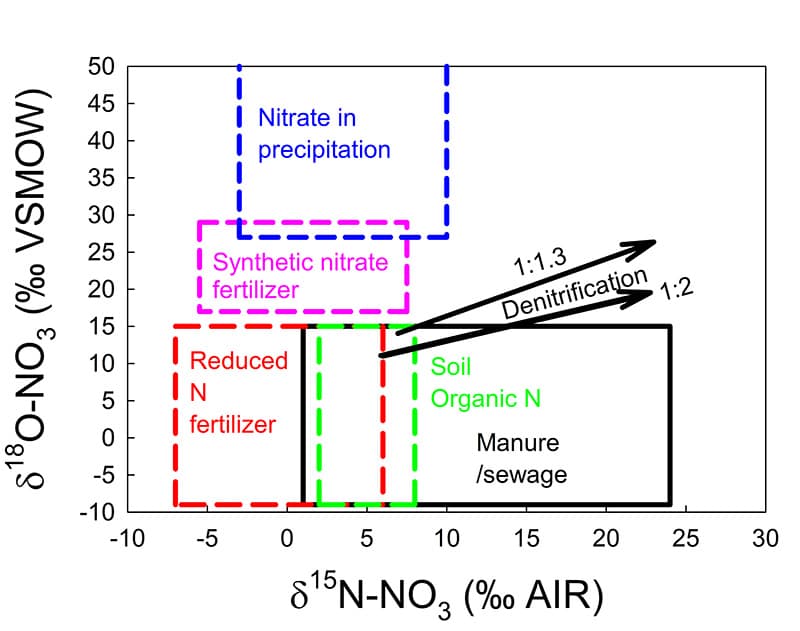
δ15N and δ18O of Nitrate is analyzed by isolation via ion exchange and then EA/TCEA-IRMS analysis. A minimum concentration of 3 mg/L (as nitrate) is required for analysis.
Sample Size
We recommend sending 1 liter of water. Analyses on smaller amounts are possible. If you wish to analyze less than 500 mL please contact us first.
Sample Container
We recommend a 1 liter HDPE or plastic bottle.
Preservative
The sample should be field filtered using at least 0.45 micron or smaller pore-size diameter filter. The sample must be kept chilled to minimize microbial action.
Holding Time
Samples should be sent in within two weeks of sampling.
Shipping
Samples must be shipped on ice and overnighted to our lab. Do not ship on a Friday as there is no one to receive the sample and put in refrigeration over the weekend. Please include a Chain of Custody (COC) form.
Questions we can answer
- What is the source of nitrate in a water source and is the concentration at levels dangerous to human health?
- Is nitrate from reduced nitrogen fertilizer?
- Is nitrate from synthetic fertilizer?
- Is nitrate from septic systems?
- Is nitrate from manure applications?
- Is denitrification occurring in a groundwater aquifer system?
Water Chemistry
Sampling Guidelines and Analytical Procedures
Anions
In the field, 250 mL of filtered water (using a 0.45 micron filter) is collected in a HDPE or plastic bottle. Water is inlet into an Ion Chromatograph (IC) for anion concentration analysis at the lab.
Cations
In the field, 250 mL of filtered water (using a 0.45 micron filter) are collected in a separate HDPE or plastic bottle and preserved with nitric acid. Water is inlet into an inductively coupled plasma optical emission spectrometer (ICP-OES) for cation concentration analysis at the lab.
Smaller sample volumes can be analyzed for anion and cation concentrations. Please contact the lab for more information.
Preservative
The sample must be kept chilled prior to and during shipment.
Holding Time
Samples should be overnighted to the laboratory. Sampling events should be planned for Monday through Thursday to allow receipt of the sample within 48 hours. If shipment of the sample cannot happen the same or next day the sample should be kept refrigerated.
Shipping
Samples must be shipped on ice and overnighted to our lab. Do not ship on a Friday as there is no one to receive the sample and put in refrigeration over the weekend. Please include a Chain of Custody (COC) form.
Analysis Suites
| Analytes/properties tested for | WAB (Basic) | WAE (Environmental) | WAO (Oilfield) | WAFA (Flow Assurance) | WAC (CO2) |
|---|---|---|---|---|---|
| pH | yes | yes | yes | yes | yes |
| Conductivity | yes | yes | yes | yes | yes |
| Alkalinity | yes | yes | yes | yes | yes |
| TDS (calculated) | yes | yes | yes | yes | yes |
| Sodium | yes | yes | yes | yes | yes |
| Potassium | yes | yes | yes | yes | yes |
| Magnesium | yes | yes | yes | yes | yes |
| Calcium | yes | yes | yes | yes | yes |
| Barium | no | yes | yes | yes | yes |
| Strontium | no | yes | yes | yes | yes |
| Iron | no | yes | yes | yes | yes |
| Manganese | no | yes | yes | yes | yes |
| Lithium | no | yes | yes | yes | yes |
| Boron | no | yes | yes | yes | yes |
| Silicon | no | no | yes | yes | yes |
| Zinc | no | no | yes | yes | yes |
| Aluminum | no | no | no | no | yes |
| Cadmium | no | no | no | no | yes |
| Cobalt | no | no | no | no | yes |
| Chromium | no | no | no | no | yes |
| Copper | no | no | no | no | yes |
| Molybdenum | no | no | no | no | yes |
| Nickel | no | no | no | no | yes |
| Phosphorus | no | no | no | no | yes |
| Vanadium | no | no | no | no | yes |
| Sulfate | yes | yes | yes | yes | yes |
| Chloride | yes | yes | yes | yes | yes |
| Fluoride | no | yes | no | no | no |
| Bromide | no | yes | yes | yes | yes |
| Iodide | no | no | no | no | yes |
| Nitrate | no | yes | no | no | yes |
| Phosphate | no | yes | no | yes | yes |
| Sulfide | no | no | no | yes | no |
| DIC | no | no | no | yes | yes |
| TSS | no | no | no | yes | yes |
Custom analysis packages available on request - call us at (217) 398-3490 or email DLChampaignProjectManagement@stratumreservoir.com for a quote.
Questions we can answer
- What is the concentration of a specific metal in a water sample?
- Have deeper saline fluids higher in chloride and sodium migrated into shallower groundwater aquifers?
- What is the concentration of lithium in produced water?
- Are waters from different origins mixing?
- Is subsurface carbon sequestration successfully trapping dissolved carbon dioxide in the subsurface?
- What is the baseline water quality prior to oil and gas drilling?